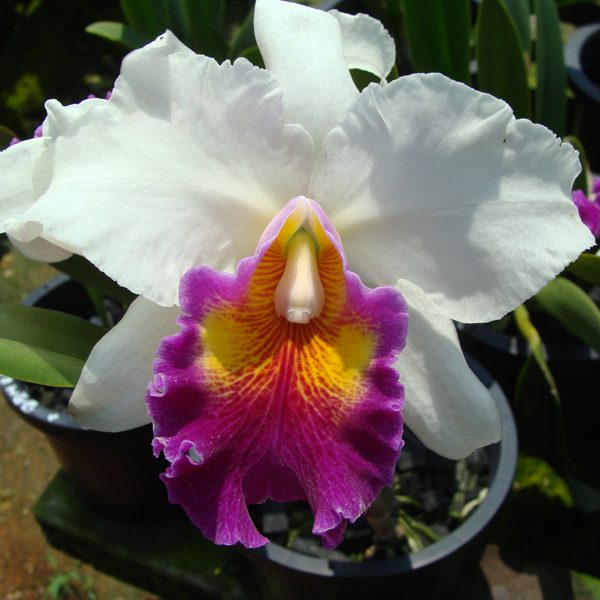
Understanding the Parts of an Orchid Name
An orchid name can look like a long string of words and letters, but each part has a clear purpose. Think of it like a person’s full name: first name, middle name, last name, and maybe some titles or honors after it. In orchids, we have the genus, the grex, the cultivar name, and sometimes award letters. These parts work together to tell us exactly which plant we are talking about, especially when many look similar.
Genus: The Broad Family Group
The first part of an orchid name is the genus. This is like the family name in human terms. It groups orchids that share basic botanical traits. For example, Cattleya, Phalaenopsis, Dendrobium, and Vanda are all genera. The genus name is always capitalized and written in italics when printed. It tells you the broad category but not the specific plant. Many orchids share the same genus, so we need more details to identify one exact plant.
Grex: The Hybrid Group Name
After the genus comes the grex name. This name applies to all offspring from a specific cross between two parent plants. It is not italicized, but the first letter is capitalized. Think of the grex as a sibling group—all the plants in it come from the same two parents, just like brothers and sisters in a family. They may look different due to how genes mix, but they share the same parentage. The grex name is registered and unique to that cross. For example, if you cross a Cattleya warscewiczii with a Cattleya dowiana, all the seedlings from that cross belong to the same grex, which might be named something like Cattleya Hardyana.
Cultivar Name: The Individual Plant’s Identity
Within a grex, individual plants can vary. To tell one outstanding plant apart from its siblings, growers give it a cultivar name. This name is placed in single quotes. It identifies one specific plant and all its genetically identical copies (called mericlones). The cultivar name is not shared by every plant in the grex—only that one selected individual and its clones. For example, in the name Brassolaeliocattleya Chia Lin ‘Red Rose’, the grex is Chia Lin, and ‘Red Rose’ is the cultivar name of a particular plant that stood out for its qualities.
Award Letters: Recognizing Quality
After the cultivar name, you may see letters and slashes. These indicate awards the plant has received for quality or cultivation. Awards are given by judging bodies after evaluating the flower or the plant’s health. The letters stand for different levels of recognition. For example, AM means Award of Merit, FCC means First Class Certificate, and HCC means Highly Commended Certificate. These are based on a point scale—AM is for scores of 80 to 89, FCC for 90 or above, and HCC for 75 to 79. The letters after the slash show which organization gave the award, such as AOS for the American Orchid Society.
How Awards Are Written and What They Mean
Awards are always written after the cultivar name, separated by a slash. The part before the slash is the award type; the part after is the awarding body. For example, AM/AOS means the plant received an Award of Merit from the American Orchid Society. FCC/AOS means a First Class Certificate from the same group. Some plants have multiple awards from different groups, like AM/AOS, SM/JGP—this means it got an Award of Merit from AOS and a Silver Medal from the Japan Grand Prix International Orchid Festival. These awards belong only to that specific plant and its clones, not to every plant in the grex.
Examples from Real Orchid Names
Looking at real examples helps make this clear. Take Brassolaeliocattleya Chia Lin ‘Red Rose’ AM/AOS, SM/JGP. Here, Brassolaeliocattleya is the genus, Chia Lin is the grex, ‘Red Rose’ is the cultivar name, and the plant earned an Award of Merit from the AOS and a Silver Medal from JGP. Another example: Cattleya violacea ‘Muse’ FCC/AOS shows a species (not a hybrid, so no grex) with a cultivar named ‘Muse’ that received a First Class Certificate from AOS. For a hybrid with multiple awards: Brassolaeliocattleya Irene Finney ‘York’ AM/AOS means the grex is Irene Finney, the cultivar is ‘York’, and it got an Award of Merit from AOS. Some plants get special recognition like JC/AOS, which stands for Judges’ Commendation—given when at least 75% of judges agree the plant has a distinctive trait worth noting, even if it doesn’t fit the usual scoring.
Why This System Matters for Growers
This naming system helps everyone talk about the exact same plant. Without it, confusion would be common—especially since many orchids look alike or share parentage. The genus gives the broad group, the grex tells us the parent cross, the cultivar names the individual standout, and the awards show its recognized quality. Whether you are buying, growing, or showing orchids, knowing how to read the name means you know exactly what you are getting. It connects the plant to its history, its breeding, and its achievements—all in a few words and letters.
Award Criteria and Scoring Details
The American Orchid Society uses a 100-point scale to evaluate flower quality for its awards. A Highly Commended Certificate (HCC) is given to orchids scoring between 75 and 79 points inclusive. An Award of Merit (AM) is awarded for scores from 80 to 89 points inclusive. The highest honor, the First Class Certificate (FCC), is reserved for orchids scoring 90 points or more. For cultural excellence, the Certificate of Cultural Merit (CCM) requires the plant to have been in the exhibitor’s care for at least 12 months and to score between 80 and 89 points for culture, while the Certificate of Cultural Excellence (CCE) follows the same care requirement but demands a culture score of at least 90 points. The Judges’ Commendation (JC) is awarded when at least 75% of judges agree the plant exhibits a distinctive trait worthy of recognition, even if it does not fit standard scoring categories.
Award Notation and Plant Identification
Awards are recorded after the cultivar name, separated by a slash indicating the awarding body—for example, AM/AOS means an Award of Merit granted by the American Orchid Society. The cultivar name, enclosed in single quotes, identifies a specific individual plant and its genetically identical mericlones, not all plants of the same hybrid. The AOS maintains a searchable database containing over 100,000 photos of award-winning orchids, including detailed data on award history, parentage, and family lineage. Other organizations use similar notation: OSROC (Orchid Society of the Republic of China, Taiwan) awards AM/OSROC; JGP (Japan Grand Prix International Orchid Festival) uses SM/JGP for silver medals and BM/JGP for bronze; TOGA (Taiwan Orchid Growers Association) issues BM/TOGA for bronze medals. Examples from the Orkpedia library include Cymbidium Golden Elf ‘Sundust’ HCC/AOS, Laeliocattleya Mem Robert Strait ‘Blue Hawaii’ JC/AOS, Potinara Ahchung Yoyo ‘Little Goldfish’ BM/TOGA, Brassolaeliocattleya Chun Yeah ‘Yellow Swallow’ AM/OSROC, Vanda Robert’s Delight ‘Garnet Beauty’ FCC, and Ascocenda Su-fun Beauty ‘Orange Belle’ AM/AOS.
Sources
Based on: aos.org · Wikipedia. Written and checked by the Orkpedia editors.