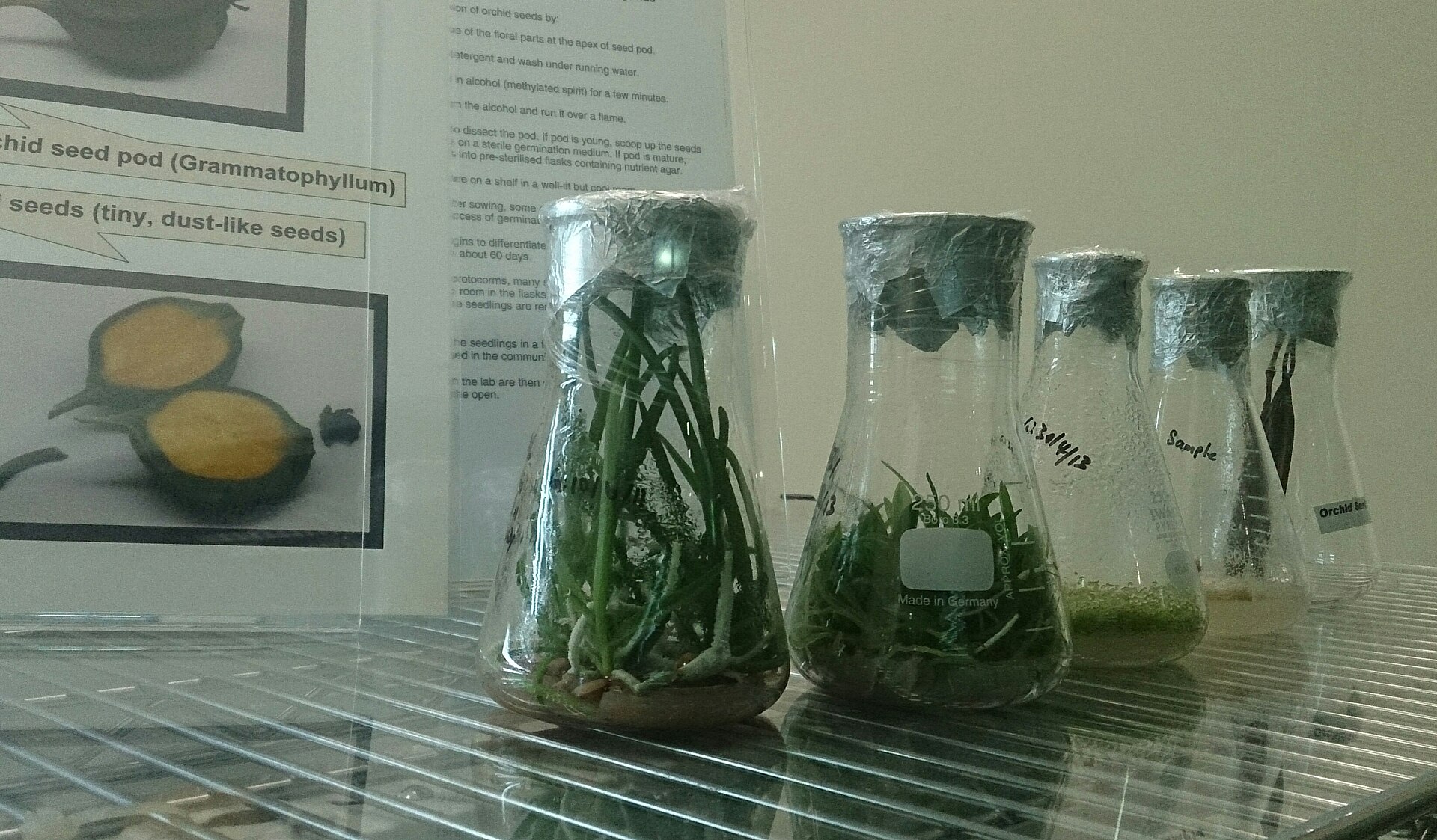
Starting in a Sterile Flask
The journey of a lab-grown orchid begins in a glass flask under completely sterile conditions. This is where tiny pieces of plant tissue, called explants, are placed on a special growth medium. The explant might be a small piece of stem, bud, or other plant part taken from a healthy mother plant. Before it goes into the flask, the tissue is carefully cleaned using washes of bleach and alcohol, then rinsed with sterilized water to remove any viruses, fungi, or other contaminants. Only clean, healthy tissue is used to give the new plant the best start.
The growth medium inside the flask is like a nutrient-rich jelly. It contains water, sugars for energy, vitamins, minerals, and plant hormones that guide how the tissue develops. A gelling agent, usually agar, holds everything in place so the explant stays supported as it grows. Depending on what the grower wants, the medium can be adjusted—for example, adding certain hormones can encourage the formation of shoots. This entire process happens in a sterile environment to prevent contamination, which could ruin the culture.
Multiplying the Plantlets
Once the explant begins to grow and form small shoots, the multiplication stage starts. This is where one tiny piece of tissue can become many plants. The shoots that develop are carefully removed and placed back onto fresh growth medium to encourage even more growth. Over time, through repeated cycles, a single explant can produce dozens, hundreds, or even thousands of plantlets.
If the tissue grows as a mass of undifferentiated cells called callus, it can be chopped into smaller pieces and recultured to produce more callus or to stimulate shoot formation. When the tissue has formed small plantlets, hormones are often added to the medium to help them create side shoots or offshoots. These new shoots can then be separated and grown further. This stage allows growers to produce large numbers of identical orchids quickly, which is especially useful for rare or slow-growing varieties.
Encouraging Root Growth
After multiplication, the young plantlets need to develop roots before they can survive outside the flask. This is done by transferring them to a rooting medium. This medium has a different balance of plant hormones—specifically, a higher level of auxin compared to cytokinin—which encourages root formation instead of shoot growth. Over time, tiny white roots begin to emerge from the base of each plantlet.
Once roots have formed, the plantlets are ready for the next step: preparing to leave the sterile environment. This preparation is called hardening or acclimatization. Even though they have roots, the plantlets are still used to living in high humidity and low light inside the flask. They need time to adjust to normal air conditions, where humidity is lower and light levels are stronger. This step is crucial because moving them too quickly can cause shock or drying out.
Leaving the Flask: Deflasking
Deflasking is the moment when the orchid leaves the flask and enters the real world. The plantlets are gently removed from the gel-like medium, and any remaining agar is rinsed off with clean, sterilized water. This must be done carefully to avoid damaging the delicate roots and shoots.
After rinsing, the young orchids are placed in a community pot—a shared container filled with a fine, moist growing mix like sphagnum moss or a special seedling blend. The pot is then covered with clear plastic or placed inside a humidity tent to keep the air around the plants very moist. This high humidity helps prevent the leaves from drying out while the orchids adjust to life outside the sterile flask. They are kept in warm, shaded light, not direct sun, to avoid stress.
Over the next few weeks, the grower watches closely. The plastic cover may be opened a little more each day to slowly lower the humidity and help the plants harden off further. Watering is done with care—enough to keep the medium damp but not soggy. Fertilizer is usually avoided at first, since the young plants are still sensitive.
Growing in Community Pots
In the community pot, the young orchids continue to grow stronger. They develop more leaves, and their root systems become more established. This stage can last several months, depending on the orchid type and growing conditions. The goal is to let each plant build up enough energy and resilience to survive on its own.
As they grow, the orchids may begin to look like miniature versions of their adult form. Their leaves firm up, and their stems thicken. At this point, the grower starts to treat them more like regular seedlings—gradually increasing light exposure, watering as needed, and beginning to use very dilute fertilizer if the plants show signs of needing it.
Eventually, when the orchids are large enough to handle individually, they are separated and moved into their own small pots. This is called potting up. Each plant gets its own space with fresh growing medium, allowing it to continue developing without competition.
Waiting for the First Flower
It takes time for a young orchid to bloom. Even after leaving the flask and growing in its own pot, it may not flower for a year or more. The orchid needs to mature fully, building up enough strength to support a flower spike and blossoms. During this time, it needs the right balance of light, water, humidity, and nutrients—just like any orchid, whether lab-grown or not.
When the plant is ready, a small shoot will emerge from the base or between the leaves. This is the flower spike. It grows slowly, often over several weeks, and buds begin to form along its length. Eventually, the buds open to reveal the first flowers—a sign that the orchid has reached maturity.
Seeing that first bloom is a rewarding moment. It means the tiny tissue from the flask has become a healthy, flowering plant. From sterile flask to flowering pot, the orchid’s journey shows how science and care can work together to bring beautiful plants into homes.
Sources
Based on: Wikipedia · Wikipedia. Written and checked by the Orkpedia editors.