Why Orchid Seeds Need Help to Start
Orchid seeds are incredibly tiny, often smaller than a grain of sand. Because they are so small, they contain almost no stored food to support the young plant when it first begins to grow. In the wild, this means the seed cannot develop on its own. Instead, it must form a partnership with a specific type of fungus that lives in the soil or on tree bark. This fungus acts like a nurse, supplying the seed with the sugars and nutrients it needs to begin life. Without this fungal help, the seed would simply remain dormant or die. This natural partnership is essential for orchids to reproduce in nature.
What Happens in the Natural Partnership
When an orchid seed lands in a suitable place and comes into contact with the right fungus, the fungus threads, called hyphae, enter the seed. Inside the seed, the fungus forms small, coiled structures known as pelotons. These pelotons are where the exchange of nutrients happens. The fungus breaks down complex materials and delivers simple sugars to the developing orchid embryo. At this early stage, the seed swells and forms a small, rounded body called a protocorm. The protocorm has no leaves or roots yet but contains the basic cells that will grow into a plant. Over time, if the fungus continues to support it, the protocorm develops a growing tip and begins to form the first roots and shoots. This entire process, where the fungus and seed work together, is known as symbiotic germination.
How Lewis Knudson Changed Orchid Growing
For many years, scientists believed that orchids could only grow if they were partnered with their natural fungus. This made growing orchids from seed very difficult and unpredictable, as it depended on finding the right fungal partner in the right conditions. In 1922, Lewis Knudson, a botanist working at Cornell University, discovered a way to bypass the need for the fungus. He found that by placing orchid seeds on a special gel made from agar and sugar, the seeds could germinate and grow just as well — or sometimes better — without any fungus at all. This breakthrough meant that orchid seeds could be started in a clean, controlled environment using only simple nutrients. His method was called asymbiotic germination because it did not require symbiosis with a fungus.
Why Glass Flasks Are Used Today
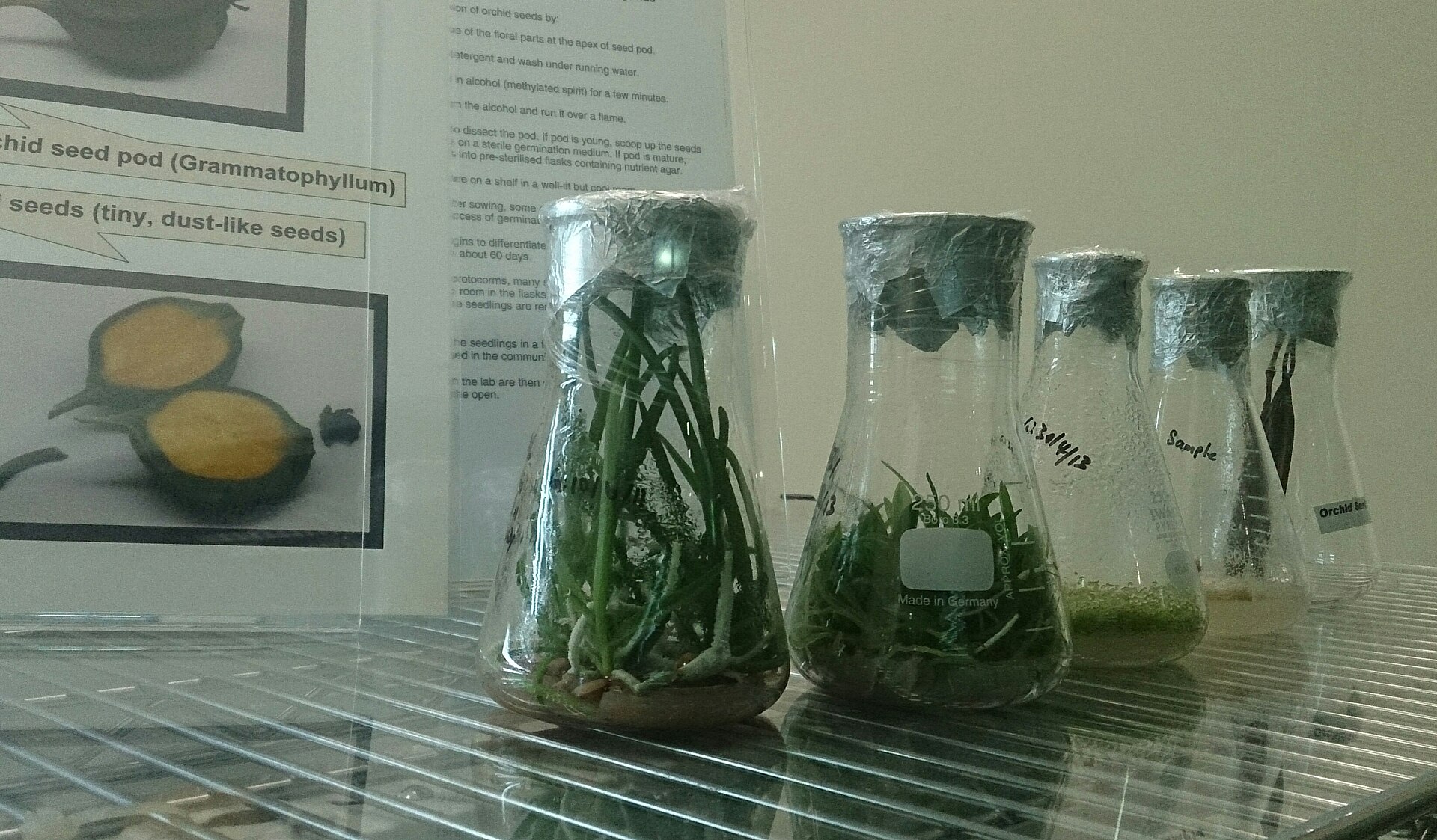
Once Knudson’s method was proven, growers began using glass flasks to raise orchid seedlings from seed. The flasks serve as tiny, protected greenhouses. They are made of clear glass so light can reach the seedlings, and they can be sealed with a stopper or cotton plug to keep out contaminants. Inside the flask, a sterile gel — often based on Knudson’s original recipe — holds the seeds and provides them with sugar and minerals. Because the flask is sealed, it prevents mold, bacteria, and other fungi from invading and harming the delicate seedlings. This sterile environment is crucial, as orchid seedlings are very vulnerable in their first weeks of life. The flask allows growers to monitor progress easily and gives each seedling a clean, even start.
What Happens Inside the Flask
When orchid seeds are placed on the nutrient gel inside a sterile flask and kept under gentle light, they begin to swell. Within days or weeks, depending on the species, the seed forms a protocorm. This small, bump-like structure is the first sign of life. Over time, the protocorm develops a growing point and starts to produce the first tiny root and shoot. These early growths are very fine and may look like threads under a magnifying glass. As the seedling grows, it begins to look more like a miniature orchid plant. It may develop its first leaf or two, though these are often very small and simple. All of this happens while the seedling remains inside the flask, feeding on the nutrients in the gel. No additional feeding or watering is needed during this stage, as the sealed environment provides everything the young plant requires.
When the Seedlings Leave the Flask
After several weeks or months, the orchid seedlings have grown large enough to survive outside the flask. At this point, they are carefully removed — a process called deflasking. The gel is gently rinsed from the roots, and the tiny plants are placed into a moist, well-drained mix such as fine bark, sphagnum moss, or special orchid compost. They are kept in a humid, shaded area at first, often under a clear cover or in a propagation case, to help them adjust to the drier air and lower nutrient levels outside the flask. Over time, as they grow stronger, they are given more light and treated like any other young orchid. This flask-to-pot journey allows growers to produce many healthy orchids from a single seed pod, making it possible to grow rare or hybrid varieties that would be hard to propagate any other way.
Lewis Knudson and the Development of Asymbiotic Germination
Lewis Knudson (1884–1958) was an American botanist who dedicated most of his professional life to the study of the biology, reproduction and propagation of orchids. He obtained his Bachelor of Science and Arts degree at the University of Missouri in 1908 and came to Cornell University as an assistant in plant physiology. Here he earned his doctorate, was appointed assistant professor of plant physiology in 1911 and was made acting head of that department in 1912. In 1916, his department became incorporated into the department of botany and he became a professor of botany. In 1941 he was named the head of this department. He retired in 1952. Orchid seeds are extremely small and hold scant sustenance. For this reason, in nature they need to associate with a fungus during germination which provides them nutrients required for growth and development. This process is known as “symbiotic germination” and until 1922 was the only known method of seed based propagation of orchids. That year, Lewis Knudson published an article describing an artificial method to germinate orchids without the participation of a fungus. This method, known as asymbiotic propagation, makes use of micropropagation techniques to achieve the germination and development of plantules in an artificial culture medium under sterile conditions. Currently, the growth medium known as “Knudson culture medium” continues being used around the world to germinate orchids fast and efficiently. Knudson originally published his work on asymbiotic germination in a Spanish-language journal which was little known at the time; and he thus republished the next year in English in a journal with wide circulation.
Selected Publications by Lewis Knudson
Knudson L. 1921. La germinación no simbiótica de las semillas de orquídeas. Boletin de la Real Sociedad Española de Historia Natural 21: 250-260 Knudson L. 1922. Nonsymbiotic germination of orchid seeds. Botanical Gazette 73: 1-25 Knudson L. 1929. Physiological investigations on orchid seed germination. Proc. of the International Congress of Plant Science 2: 1183-1189 Knudson L. 1951. Nutrient Solutions for Orchids. Botanical Gazette, Vol. 112, No. 4, pp. 528–532 Knudson L. 1956. Self pollination in Cattleya aurantiaca (Batem.) P. N. Don. Am. Orchid Soc. Bull. 25: 528-532
Eponyms
(Rosaceae) Prunus × knudsonii Rosend. & Butters
Sources
Based on: Wikipedia · Wikipedia · Wikipedia. Written and checked by the Orkpedia editors.