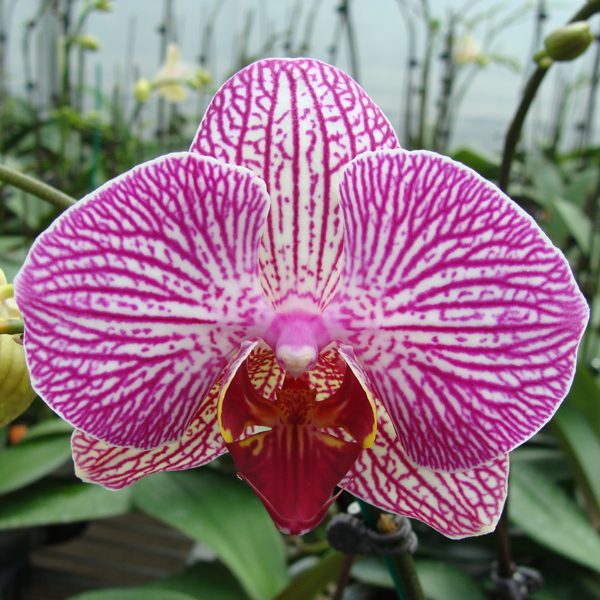
What a Phalaenopsis Orchid Looks Like
Phalaenopsis orchids, often called moth orchids, grow with a single upward stem. Their leaves are thick and leathery, usually arranged in two rows along the stem. The roots are long and coarse, designed to cling to surfaces like tree bark or rock. From the stem, a flowering spike grows upright or sometimes hangs down, bearing several flat, long-lasting flowers. These flowers spread their sepals and petals wide apart, with the lip often having three lobes and being firmly attached to the central column. The overall look is elegant and sturdy, built for long display.
Where They Come From in Nature
In the wild, Phalaenopsis orchids grow across parts of Asia, New Guinea, and Australia. They are most commonly found in Indonesia and the Philippines. There, they live as epiphytes, meaning they grow on trees without harming them, or sometimes as lithophytes, clinging to rocks. Their natural habitat is warm and humid, with filtered light shining through the forest canopy. This background helps explain what they need to thrive indoors.
Light: Bright but Indirect
Phalaenopsis orchids need bright light to grow well and bloom, but direct sunlight can harm their leaves. A windowsill that gets morning sun or light filtered through a sheer curtain is ideal. Think of the light they get in nature — dappled and soft, not harsh and direct. If the leaves start to look yellow or reddish, they may be getting too much sun. Dark green leaves that never bloom might mean the light is too low. Aim for a balance where the leaves stay firm and medium green.
Watering: Let It Dry Slightly Between
These orchids store water in their leaves and roots, so they don’t need constant moisture. Water them when the top inch of the potting mix feels dry to the touch. When you water, pour slowly until it runs out the bottom of the pot, then let it drain completely. Never let the pot sit in water. Overwatering is a common mistake — their roots need air as much as moisture. In cooler or darker conditions, they’ll need water less often. In warm, bright spots, they may dry out faster. Adjust based on how the plant feels, not a fixed schedule.
Temperature: Warm and Steady
Phalaenopsis orchids prefer temperatures similar to a comfortable home — not too hot, not too cold. They thrive when daytime temperatures are warm and nights are slightly cooler, but avoid extremes. Cold drafts from windows or doors can cause buds to drop or leaves to yellow. Similarly, placing them near heaters or stoves can dry them out too quickly. A stable environment helps them grow steadily and prepares them to bloom again.
Encouraging Reblooming
After the flowers fade, the orchid can bloom again with proper care. Cut the flower spike just above a node — a small bump on the stem — if it’s still green. This may encourage a new shoot to form from that point. If the spike turns brown and dry, cut it off at the base. Continue giving the plant bright, indirect light, proper watering, and steady temperatures. Over time, a new spike may emerge. It can take several months, so patience is key. The plant needs to store enough energy to support another round of flowers.
Repotting: When and How
Repot your Phalaenopsis every one to two years, or when the potting medium breaks down and feels soggy or compacted. The best time is after blooming, when the plant is not actively flowering. Use a mix made for orchids — usually bark-based — that allows air to reach the roots. Gently remove the old medium, trim any dead or mushy roots, and place the plant in a pot that’s just large enough for the roots to fit comfortably. Center the plant so the base of the leaves sits just above the medium. Water lightly after repotting to help it settle.
Native Habitat and Growth Pattern
Phalaenopsis orchids are native to Asia, New Guinea, and Australia, with the majority of species occurring in Indonesia and the Philippines. They grow as monopodial epiphytes or lithophytes, meaning they typically attach to trees or rocks rather than growing in soil. Their long, coarse roots are adapted to absorb moisture and nutrients from the air and surrounding debris, and they possess pneumatodes — small openings that allow for gaseous exchange in the photosynthetic roots. The stems are short and leafy, often hidden by overlapping leaf bases, and the leaves are arranged in two rows, large, leathery, and oblong to elliptic in shape, sometimes appearing succulent.
Floral Characteristics and Pollination Biology
The flowers of Phalaenopsis are long-lasting and flat, often fragrant, and arranged on erect to hanging racemes or panicles that may branch near the end. The sepals and petals are free and spread widely apart, with lateral sepals usually larger than the dorsal sepal and petals significantly wider than the sepals. The labellum is stiffly joined to the column and features three lobes, with the side lobes erect and parallel, and the middle lobe sometimes bearing appendages or antennae. Following pollination, the stigmatic cavity closes due to column swelling, enclosing the pollinia. Pollen tubes begin to form after enclosure, and in Phalaenopsis aphrodite, they enter the ovary within three days. By 15 days post-pollination, pollen tubes are evenly distributed in the placental cavities. Around 60 days after pollination, 30.6% of pollen tube tips begin to enter the ovule micropyles, and fertilization occurs between 65 and 70 days after pollination.
Unique Post-Pollination Adaptation
In certain species of the subgenus Polychilos, such as Phalaenopsis violacea, the petals and sepals do not senesce after pollination as they do in most plants. Instead, they avoid programmed cell death by developing chloroplasts, turning green, becoming fleshy, and beginning to photosynthesize — effectively functioning as leaves. This adaptation allows the plant to repurpose floral tissues for energy production after serving their initial role in attracting pollinators and protecting reproductive organs.
Floral Fragrance and Environmental Response
The fragrance of Phalaenopsis bellina has been analyzed and found to consist of approximately 79 compounds, primarily terpenoids, with the scent being most intense in the morning. Additionally, phenylpropanoid enzymes in Phalaenopsis are upregulated during the process of plant acclimatization to varying levels of photosynthetic photon flux, indicating a biochemical response to light intensity changes in their environment.
Taxonomic History and Classification
The genus Phalaenopsis was first formally described in 1825 by Carl Ludwig Blume, with the description published in Bijdragen tot de flora van Nederlandsch Indië. The name Phalaenopsis derives from the Ancient Greek word φαλαινα (phalaina), meaning ‘a kind of moth’, combined with the suffix -opsis, meaning ‘having the appearance of’ or ‘like’. In horticultural contexts, the genus is abbreviated as Phal. The genus is divided into several subgenera or sections, though not all are monophyletic. The subgenus Polychilos is monophyletic and split into two subclades. The subgenus Phalaenopsis is paraphyletic under its current definition, and the subgenera Aphyllae and Parishianae, as currently defined, are not monophyletic. The monotypic subgenus Proboscidioides, containing only Phalaenopsis lowii, shows a close phylogenetic relationship to the subgenus Aphyllae. The former genus Ornithochilus has been merged into Phalaenopsis and is considered by some to be a subgenus; its members are distinguished by 4-lobed, fringed labella with a short, curved spur located near the middle of the lip, and they were historically native to China, the Himalayas, and Southeast Asia.
Sources
Based on: Wikipedia. Written and checked by the Orkpedia editors.