Orchid technology
Orchid cloning and tissue culture
How one outstanding orchid becomes thousands of identical plants, and how orchid seed is grown in the laboratory.
Why orchids are grown in the lab
Orchid seeds are as fine as dust and carry almost no stored food. In nature they only germinate with help from specific fungi, and very few survive. Laboratory culture solved this, and it is the reason high-quality orchids are now affordable around the world.
Two techniques are used, and both happen inside sterile flasks:
| Seed sowing (asymbiotic germination) | Meristem cloning (mericloning) | |
|---|---|---|
| Starts from | Seed from a hand-pollinated cross | A tiny piece of growing tissue from one plant |
| Result | Seedlings: every plant is genetically different | Mericlones: copies of the mother plant |
| Used for | Creating new hybrids and growing species | Multiplying an outstanding, proven plant |
| Pioneer | Lewis Knudson, 1922: sugar-and-mineral agar without fungi | Georges Morel, 1960: meristem culture of Cymbidium |
The cloning process, step by step
1. Choose the mother plant. Growers pick a plant with outstanding flowers, often an award winner, and make sure it is healthy and virus-free.
2. Take the explant. A new growth or flower-spike bud is removed, and the tiny growing tip (the meristem) is cut out under a microscope.
3. Sterilise and place in culture. The tissue is surface-sterilised and placed on or in a nutrient medium containing minerals, sugar and plant growth regulators, all in sterile flasks.
4. Multiply. The tissue forms small green balls called protocorm-like bodies (PLBs). These are cut up and re-cultured again and again; each piece becomes more PLBs, so numbers grow quickly.
5. Grow into plantlets. When enough PLBs exist, they are moved to a medium that lets them develop leaves and roots.
6. Deflask and harden off. Plantlets are removed from the flask, washed, and planted in community pots under shade and high humidity, then gradually exposed to normal growing conditions.
Somaclonal variation
Cloning is not perfect. When tissue is multiplied for too many cycles, some plants can change, producing different colours, shapes or deformed flowers. Good laboratories limit the number of cycles and start again from fresh tissue to keep mericlones true to the mother plant.
Seed sowing in brief
- A ripe or green seed pod from a planned cross is surface-sterilised and opened in a clean hood.
- Seed is spread on sterile agar medium in flasks.
- Seeds swell into protocorms, then grow leaves and roots over several months.
- Seedlings are thinned (replated) into fresh flasks, then deflasked like mericlones.
Glossary
| Term | Meaning |
|---|---|
| Meristem | The actively dividing tissue at a growing tip |
| Mericlone | A plant produced by meristem culture; a genetic copy of its mother plant |
| PLB | Protocorm-like body: a small green mass that can grow into a plant |
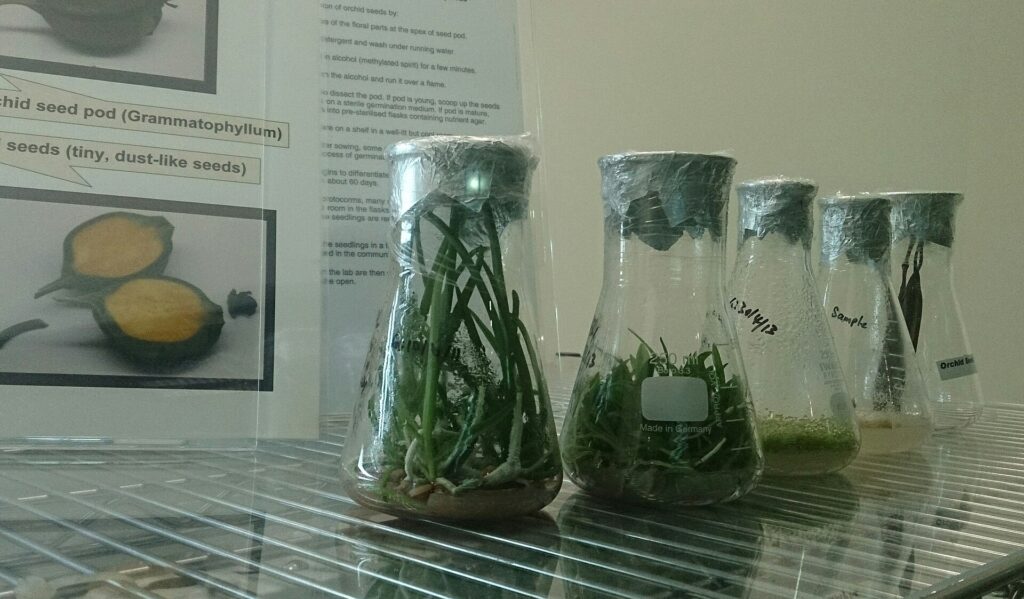
| Flask | Sealed glass or plastic container holding sterile medium and plants |
| Compot | Community pot: many young plants potted together after deflasking |
| Keiki | A small plantlet that grows naturally on the mother plant |
Read our story From flask to flower to learn how seedlings are grown on after the lab, and Mericlone or seedling? to see what it means for the plant you buy.
Lab photo: Photo: ProjectManhattan, CC BY-SA 3.0 (Wikimedia Commons).
