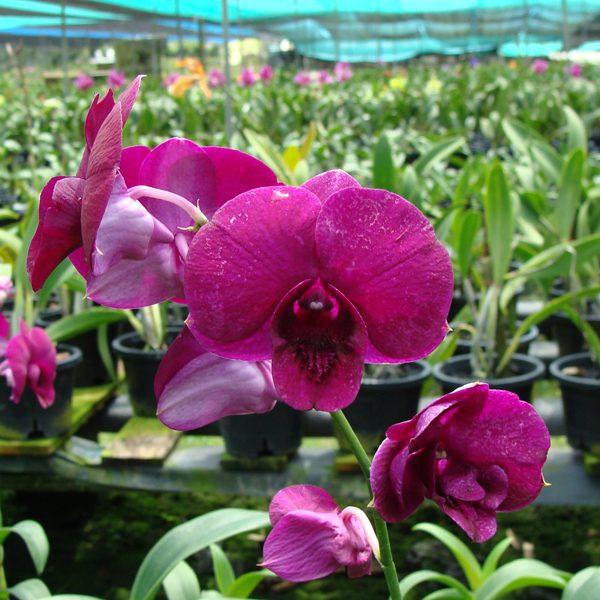
What Dendrobium Orchids Are and Where They Come From
Dendrobium is a large group of orchids that grow on trees or rocks rather than in soil. They are found across a wide area of Asia and the Pacific, including places like China, Japan, India, the Philippines, Indonesia, Australia, New Guinea, and many Pacific islands. Some also grow in the Himalayas and even in dry parts of Australia. These plants have roots that cling to surfaces and often store water in thick stems called pseudobulbs. They are known for their ability to adapt to different climates, from cool mountains to warm, humid forests.
How to Recognise Dendrobium Orchids
Dendrobium orchids usually have stems that grow sideways, forming new shoots from the base. Their stems can be thin and cane-like or thicker and cone-shaped. Leaves grow in two rows along the stem and are often long and narrow, lasting only one season. Flowers grow along an unbranched stem and can be few or many. They may stand upright or hang down and come in colours like white, green, yellow, pink, or purple. The lip of the flower is often egg-shaped and differs from the petals and sepals. Some have a raised pattern in the centre of the lip made of narrow ridges.
A Short History of Breeding
People have long been interested in Dendrobium orchids for their beauty and variety. Over time, growers have created many hybrids by crossing different species. This has led to a wide range of colours and forms, especially in groups like the noble dendrobium. Some hybrids have been named after well-known people or events, such as leaders, athletes, or anniversaries. One hybrid, Dendrobium Berry gx, has received recognition from the Royal Horticultural Society for its garden value. Breeding has also focused on traits like long-lasting flowers and resistance to pests.
Awards and Competition
The library’s own collection includes 212 Dendrobium plants, made up of 117 mericlones and 92 seedling hybrids. However, none of these plants have received awards as recorded in the catalogue. The award key explains how honours are given: flower quality is scored out of 100, with HCC for 75–79 points, AM for 80–89, and FCC for 90 or more. Cultural awards like CCM and CCE are given for how well a plant is grown, with CCM for 80–89 culture points and CCE for 90 or more. JC is given for special traits that judges agree are notable but cannot be scored in the usual way.
How to Grow Them at Home
Dendrobium orchids do best in bright, indirect light, similar to what they get under tree canopy. They need good air flow around the roots and should not sit in wet soil. Many grow well in bark or moss that lets water drain quickly. Water them when the medium is nearly dry, but avoid letting them dry out completely. They benefit from regular feeding during growing seasons with a balanced orchid fertilizer. Most prefer warm days and cooler nights, though some types can handle a wider range. After flowering, reduce water and food slightly to let the plant rest. Repot only when the medium breaks down or the plant outgrows its container, using fresh mix and a pot with good drainage.
What Our Library Holds
The library’s Dendrobium collection contains 212 plants in total. Of these, 117 are mericlones, which are copies made from tissue culture to keep the exact traits of a parent plant. The other 92 are seedling hybrids, grown from seed and showing natural variation. The catalogue lists several example plants and their parentage, such as Dendrobium Frosty Dawn from Dendrobium Dawn Maree and Dendrobium Lime Frost, and Dendrobium Ai Miyazato from Dendrobium Burana Jade and Dendrobium Sang White. Other examples include Dendrobium Mikasa ‘Pink’, Dendrobium Bobby Messina, and Dendrobium Aridang Blue. The library also notes various names like Dendrobium Strebloceras and Dendrobium discolor, showing the diversity within the group.
Growth Habits and Natural Habitat
Dendrobium orchids are primarily epiphytic or lithophytic, meaning they grow on trees or rocks rather than in soil. Their roots creep over surfaces and absorb moisture and nutrients from the air, rain, and debris around them. The genus includes more than 1,800 species found across south, east, and southeast Asia, extending to China, Japan, India, the Philippines, Indonesia, Australia, New Guinea, Vietnam, and many Pacific islands. Plants in this genus develop pseudobulbs that are hard, cane-like, cylindrical, or cone-shaped and are covered with leaf bases. Leaves are arranged in two ranks, vary from linear to oblong, and typically last only one growing season. Flowers are borne along an unbranched stem and can be resupinate or non-resupinate, lasting from short to long periods. Flower colors range from white, green, yellow, to pink and purple, often with contrasting hues in the labellum, which is egg-shaped and features a central callus of narrow, parallel ridges.
Taxonomic History and Classification
The genus Dendrobium was first formally described in 1799 by Olof Swartz in the publication Nova Acta Regiae Societatis Scientiarum Upsaliensis. Despite multiple attempts to divide the genus into smaller groups, most such classifications have not been accepted by the World Checklist of Selected Plant Families. Dendrobium remains a broadly defined genus due to its extensive diversity and overlapping characteristics among species. The lack of consensus on splitting the genus reflects the complexity of its morphology and the challenges in defining clear boundaries between groups based on traditional taxonomic traits.
Sources
Based on: Orkpedia library records · Wikipedia. Written and checked by the Orkpedia editors.