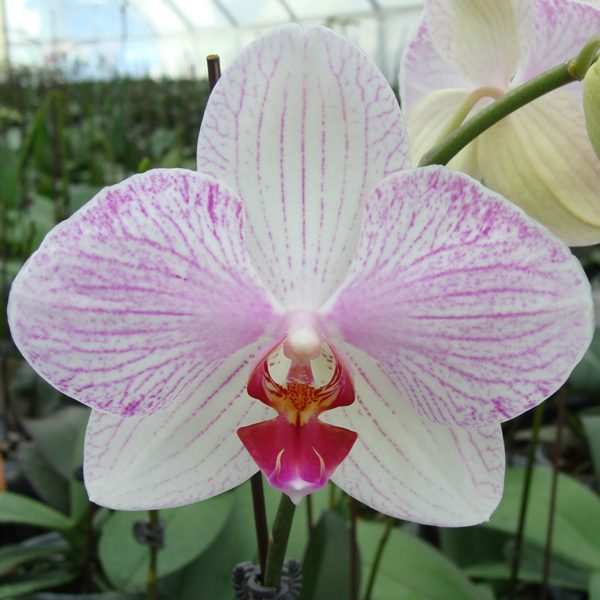
What These Orchids Are and Where They Come From
Phalaenopsis and Doritaenopsis are types of orchids commonly called moth orchids. Phalaenopsis is a genus of about seventy species in the Orchidaceae family. These plants are monopodial epiphytes or lithophytes, meaning they grow on trees or rocks with long, coarse roots and short leafy stems. Their flowers are flat and long-lasting, often arranged on branching stems. They are native to Asia, New Guinea, and Australia, with most species found in Indonesia and the Philippines. Doritaenopsis is not a separate genus but a hybrid group created by crossing Phalaenopsis with Doritis, another orchid genus. These hybrids share the same growing habits and flower structure as Phalaenopsis but may show variations in colour and form due to their mixed parentage.
How to Recognise Them
Moth orchids have short, leafy stems hidden by overlapping leaf bases. The leaves are usually arranged in two rows, large and leathery, oblong to elliptic in shape, and sometimes succulent. Flowers are flat and spread widely, with sepals and petals free from each other. The lateral sepals are typically larger than the dorsal sepal, and the petals are much wider than the sepals. The labellum, or lip, is stiffly joined to the column and has three lobes. The side lobes are erect and parallel, while the middle lobe may have small appendages. Flowers are long-lasting and often fragrant, growing on erect to hanging racemes or panicles. These features help distinguish them from other orchid types.
A Short History of Breeding
Breeding of Phalaenopsis and Doritaenopsis has focused on creating hybrids with desirable flower traits such as colour, pattern, and longevity. The library data shows many named hybrids, often resulting from crosses between specific parent plants. Examples include Phalaenopsis Diamond Beauty ‘ST-2295’ from Tinny Apple × Tinny Grace-M. Lip, and Doritaenopsis Taida Pearl from DTPS Taisuco Sweet × DTPS Taisuco Rose. Other crosses involve species like Phalaenopsis Amboinensis, Phalaenopsis Violacea, and Phalaenopsis Lueddemanniana. Breeders have also used varieties such as Phalaenopsis violacea var coerulea and hybrids like Taisuco Stripe and Taisuco Gaster equestris. These efforts have produced a wide range of cultivars with varied appearances, many of which are grown for their ornamental value.
Awards and Competition
The library data includes an award key explaining flower-quality awards from the American Orchid Society (AOS). These are scored on a 100-point scale: HCC (Highly Commended Certificate) for scores of 75 to 79 points, AM (Award of Merit) for 80 to 89 points, and FCC (First Class Certificate) for 90 points or more. However, the library’s own catalogue records no award-winning plants in the Phalaenopsis and Doritaenopsis group. The award letters as printed in the catalogue show none recorded for this group. Therefore, while the award system is defined and used elsewhere, no plants in this specific library collection have received these honours according to the current data.
How to Grow Them at Home
Grow Phalaenopsis and Doritaenopsis in bright, indirect light—avoid direct midday sun which can burn the leaves. Water when the top layer of the potting medium feels dry, but do not let the pot sit in water. These orchids prefer humidity, so misting the air around them or using a humidity tray can help, especially in dry homes. Use a well-draining potting mix made for orchids, such as bark or sphagnum moss. Repot every one to two years, or when the medium breaks down. Fertilise weakly and regularly during the growing season with a balanced orchid fertilizer. Keep temperatures warm, ideally between 18 and 30 degrees Celsius. Good air circulation prevents rot. After flowering, cut the spike just above a node to encourage a possible second bloom, or remove it entirely if it turns yellow.
What Our Library Holds
The library catalogue lists 162 plants in the Phalaenopsis and Doritaenopsis group. This includes 41 mericlones and 121 seedling hybrids. Example plants in the collection are Phalaenopsis Diamond Beauty ‘ST-2295’, Phalaenopsis Amandinal × Doritaenopsis, Doritaenopsis Taida Pearl, Phalaenopsis Salu Spot, Phalaenopsis Princess Kaiulani, Doritaenopsis Purple Martin ‘KS’, and Phalaenopsis Sogo Rose ‘Lee’. Other named examples include various crosses involving Haur Jin Princess, Ho’s Little Caroline, Phalaenopsis Yellow Peoker, Doritaenopsis Leopard Prince, and Phalaenopsis Dou dii Rose. These examples show the range of breeding work represented in the library’s collection.
Award Status in the Collection
The library catalogue records no award-winning plants in the Phalaenopsis and Doritaenopsis group. According to the award key provided, flower-quality awards such as HCC, AM, and FCC are based on a 100-point scale, but none of the plants in this collection have received such recognition as documented in the catalogue.
Parentage Details of Selected Plants
Specific parentage information is provided for several example plants in the collection. Phalaenopsis Diamond Beauty ‘ST-2295’ results from a cross between Tinny Apple and Tinny Grace-M. Lip. Phalaenopsis Amandinal × Doritaenopsis has parents Taisuco Stripe and a cross involving Taisuco Gaster equestris. Doritaenopsis Taida Pearl is derived from DTPS Taisuco Sweet crossed with DTPS Taisuco Rose. Another entry shows a complex hybrid where Phalaenopsis (Art Kaala – Yukimai × Grace Palm) × (Haur Jin Diamond × Yann Me Star ‘SL’) is listed. Phalaenopsis Salu Spot comes from Salu Peoker × Taisuco Kaaladian. A further example indicates Phalaenopsis (Salu Princess × Chiayi Spot – Golden Sun) × (Haur Jin Diamond × DTPS DA – Chien Spider Beauty). Doritaenopsis I-Hsin Petite × Dou-Dii Golden Princess is also cited. Phalaenopsis El Tigre ‘Ipoh Magic’ is a cross of Phalaenopsis Cornu-Cervi and Phalaenopsis Lueddemanniana. Phalaenopsis Penang Girl results from Phalaenopsis Venosa × Phalaenopsis Violacea. Phalaenopsis Princess Kaiulani is produced by crossing Phalaenopsis Amboinensis with Phalaenopsis Violacea Bellina ‘Pink’. Doritaenopsis Purple Martin ‘KS’ comes from Dtps Kenneth Schubert × Phalaenopsis violacea var coerulea. Finally, Phalaenopsis Sogo Rose ‘Lee’ is the offspring of Phalaenopsis Golden Sun × Phalaenopsis Sogo Kaiulani.
Additional Named Examples in the Collection
The library’s collection includes various named hybrids and crosses. These involve Haur Jin Princess crossed with Doritaenopsis in multiple combinations, such as (Taisuco Stripe × (Taisuco Gaster – Equestris)). Ho’s Little Caroline appears in several crosses with Doritaenopsis Mount Lip and related complexes. Phalaenopsis Ho’s Fantastic Mirage is also crossed with Doritaenopsis [Taisuco Stripe × (Taisuco Gaster – Equestris)]. Phalaenopsis Yellow Peoker – Ching Her Buddha appears in two forms: ‘305’ crossed with Schilleriana ‘ST’ and ‘CHT-250’ crossed with Timothy Christopher ‘Taida’. Doritaenopsis Leopard Prince is involved in crosses with Phalaenopsisschilleriana ‘flavoured’ and stuartiana ‘yellow’ (as ‘Sogo’ variant). Additional examples include Phalaenopsis Haur Jin Princess × Phalaenopsis stuartiana, Phalaenopsis Haur Jin Princess ‘2300’ × Stuartiana ‘Yellow’, Phalaenopsis Dou dii Rose × Phalaenopsis stuartiana, and Doritaenopsis I Hsin Idole × Phalaenopsis Tian Nong Stripes. The cross Phalaenopsis Amandinal × Doritaenopsis is also listed among the named examples.
Sources
Based on: Orkpedia library records · Wikipedia. Written and checked by the Orkpedia editors.