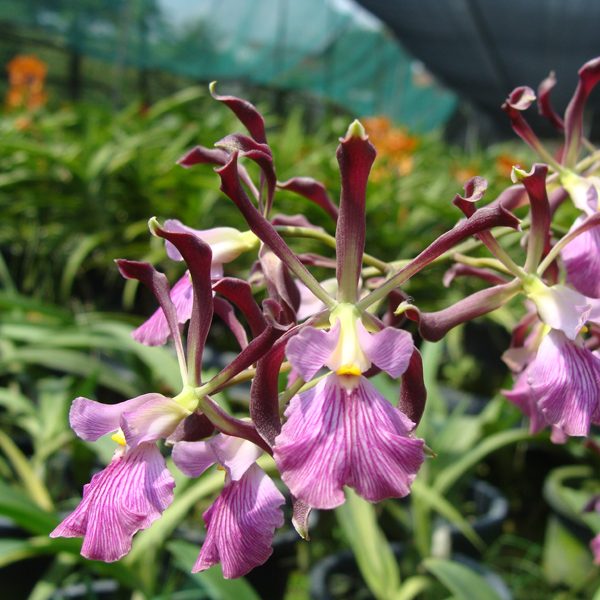
What These Orchids Are and Where They Come From
Epidendrum is a large group of orchids native to the tropical and subtropical regions of the Americas, ranging from North Carolina down to Argentina. These plants grow in a variety of settings, including on trees (epiphytic), in soil (terrestrial), and even on bare rock (lithophytic). They thrive in humid jungles, dry forests, grassy slopes, cloud forests, and sandy coastal areas. Many species have adapted well to human-disturbed environments, such as along road cuts, where they now grow more abundantly than before.
Brassavola is a smaller genus of 21 orchid species, named in 1813 by the botanist Robert Brown in honor of an Italian physician, Antonio Musa Brassavola. These orchids are found across Mexico, Central America, the Caribbean islands, and South America. Most are epiphytes, meaning they grow on trees, though some can also be found growing on rocks. A key feature is their single, thick, succulent leaf that grows from a swollen stem base called a pseudobulb.
How to Recognise Them
Epidendrum orchids vary widely in appearance. Their flowers are typically small to medium-sized and grow in clusters along a central stem, which may be simple or branched. The flowers are often not showy but can be fragrant. A key botanical trait is a small beak-like structure called the rostellum, which produces a sticky fluid. The lip of the flower is usually fused to the column, forming a nectar-holding tube, though it rarely produces actual nectar. The fruit is a dry, three-ribbed capsule.
Brassavola orchids are easier to identify by their consistent features. Each plant has one fleshy leaf per pseudobulb. The flowers are white or greenish-white, either solitary or in small clusters. The sepals and petals are long, narrow, and greenish. The lip is broad and may have a fringed edge, and it partially wraps around the column. This column has two sickle-shaped extensions on each side. Most Brassavola flowers are fragrant, but only at night, to attract moth pollinators. The bloom can last anywhere from five to thirty days, depending on the species.
A Short History of Breeding
Epidendrum has a long history in cultivation. When Carl Linnaeus first named the genus in 1763, he grouped all known tree-growing orchids under it. Over time, many species were moved to other genera as botanical knowledge advanced, but Epidendrum remains a large and diverse group. Some species have become more common due to human activity, such as road building, which creates open ground where terrestrial types can flourish.
Brassavola has played a notable role in orchid history. In 1698, Brassavola nodosa was the first tropical orchid brought from the Caribbean island of Curaçao to the Netherlands. This event marked an early milestone in the global fascination with orchids and helped start their cultivation in Europe. Brassavola species have been widely used in hybridization, especially with Cattleya and Laelia. Their genetic contribution is often seen at the start of hybrid names, such as in Blc. (Brassolaeliocattleya). Examples of hybrids include Brassavola Little Star (from B. nodosa and B. subulifolia) and various intergeneric crosses like × Rhynchovola ‘David Sanders’ and × Brassocattleya ‘Yellow Bird’ and ‘Richard Mueller’.
Awards and Competition
According to our library’s own catalogue of plants grown and sold by our nurseries, there are currently no award-winning Epidendrum or Brassavola plants recorded in the collection. The award key explains the meaning of common orchid honours: HCC (Highly Commended Certificate) for flowers scoring 75 to 79 points, AM (Award of Merit) for 80 to 89, and FCC (First Class Certificate) for 90 or more points on flower quality. CCM (Certificate of Cultural Merit) and CCE (Certificate of Cultural Excellence) are given for strong plant growth and care, requiring scores of 80–89 and 90+ respectively, with the plant needing to have been in the grower’s care for at least a year. JC (Judges’ Commendation) is for unique traits that judges feel deserve recognition but cannot be scored in the usual way. While no such awards are listed for our current stock, these standards are used in orchid shows to evaluate excellence.
How to Grow Them at Home
Both Epidendrum and Brassavola are considered among the easier orchids for beginners, thanks to their adaptability and resilience.
For Epidendrum, use a well-aerated mix that holds moisture but drains well — many growers succeed with a blend rich in humus and mixed with some sand. These plants can tolerate a range of light conditions, from bright indirect light to some morning sun. Water when the top layer of the mix feels dry, but avoid letting the pot sit in water. They do well in average household humidity, though they appreciate extra moisture in the air. Fertilise lightly during the growing season with a balanced orchid feed. Some high-elevation cloud forest species are more challenging and may not adapt well to typical home conditions, but many hybrids and lower-elevation types are reliable.
Brassavola prefers similar conditions: a loose, well-draining medium such as bark or mounted on cork or tree fern. They like bright, filtered light and can tolerate some direct sun. Water regularly during active growth, allowing the medium to dry slightly between waterings. Reduce watering slightly in cooler months. These orchids enjoy humidity and good air movement. Their night-time fragrance is a delight, so placing them where you can enjoy the evening scent is a nice touch. Feed with a diluted orchid fertiliser every other week during growth periods. They are generally forgiving of small mistakes, making them ideal for those new to orchid growing.
What Our Library Holds
Our library catalogue includes 11 Epidendrum and Brassavola plants in total. Of these, 7 are mericlones — laboratory-produced copies of a selected hybrid — and 4 are seedling hybrids, grown from seed and showing natural variation.
Examples of the plants in our collection include: Brassavola David Sander (a cross between Brassavola cucullata and Brassavola digbyana), Epidendrum Elatum × Epidendrum Atropurpurtum, Epidendrum Keith Roth Purple Glory, Epidendrum floribundum, Epidendrum Stamfordianum Var Alba, Brassavola Little Star, Brassavola nodosa, Brassavola Yellow Bird × nodosa, and Brassavola cucullata. These examples show the range of forms and colours available, from the classic white night-scented blooms of Brassavola nodosa to the richer hues found in some Epidendrum hybrids.
Sources
Based on: Orkpedia library records · Wikipedia · Wikipedia. Written and checked by the Orkpedia editors.