What Oncidium Orchids Are and Where They Come From
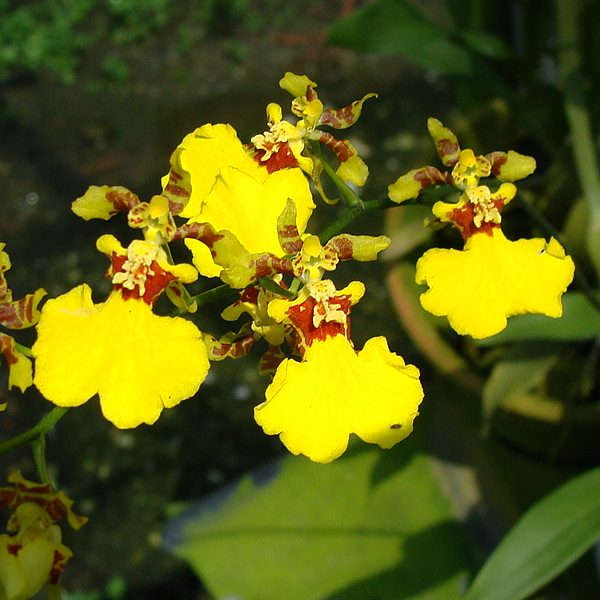
Oncidium is a genus of orchids known for their delicate, fluttering flowers that resemble dancing ladies. These plants are native to tropical and subtropical regions of the Americas, ranging from Mexico and Central America through the West Indies and down to northern Argentina. One species, Oncidium ensatum, extends into Florida. They grow in a variety of habitats, including as epiphytes on trees, lithophytes on rocks, or terrestrially in soil. The genus was first described in 1800 by the Swedish botanist Olof Swartz. The name Oncidium comes from the Greek word “onkos,” meaning swelling, referring to the prominent callus on the lip of the flower.
How to Recognise Oncidium Orchids
Oncidium plants typically have clustered pseudobulbs, each bearing up to four blunt-tipped, strap-like leaves. Their flowers grow on branching inflorescences called panicles, which emerge from the axils of recently matured growth. Each pseudobulb produces flowers only once. The blooms are resupinate, meaning they twist upside down as they open. The sepals and petals are free and range from egg-shaped to nearly circular. The most distinctive feature is the lip, which is fiddle-shaped and has a prominent warty fringe. After flowering, the plant produces a capsule fruit. These characteristics help identify Oncidium among other orchid genera.
A Short History of Breeding
Oncidium has been widely used in artificial hybridisation, often crossed with other genera to create new and interesting forms. Many hybrids have been given names as nothogenera, which are hybrid genus names. Over time, taxonomic revisions have reclassified several groups. As of April 2026, genera such as Cochlioda and Odontoglossum are now considered synonyms of Oncidium, meaning hybrids once placed in separate groups like × Odontioda, × Odontocidium, and × Wilsonara are now recognised as part of the Oncidium alliance. This reorganisation followed years of debate, including a 2009 molecular study that found the Oncidium alliance to be grossly polyphyletic. A consensus in April 2013 led to major changes, moving many Brazilian Oncidium species with a fused lateral sepal to the genus Gomesa. These changes were informed by research for the scientific publication Genera Orchidacearum Volume 5.
Awards and Competition
Our library data includes several award-winning Oncidium plants. The award key explains the meaning of the letters used in the catalogue. For example, AM/AOS stands for Award of Merit from the American Orchid Society, given to orchids scoring 80 to 89 points on a 100-point scale for flower quality. One plant listed multiple times is Oncidium Sharry Baby ‘Sweet Fragrance’ AM/AOS, indicating it has received this honour. Other award-winning plants in our library include Brassia Eternal Wind ‘Summer Dream’ SM/JOGA. These awards reflect recognition for exceptional flower quality or cultural excellence in judged competitions.
How to Grow Them at Home
Oncidium orchids can be grown successfully in home conditions with attention to their basic needs. They prefer bright, indirect light, similar to what they receive under a forest canopy. Watering should be regular during active growth, allowing the medium to dry slightly between waterings. Reduce watering after flowering when the plant enters a rest period. They thrive in intermediate to warm temperatures and appreciate good humidity. A well-draining medium, such as bark mix or sphagnum moss, is essential to prevent root rot. Fertilise lightly during the growing season with a balanced orchid fertilizer. Repot every two years or when the medium breaks down. Good air circulation helps prevent fungal issues. With proper care, these orchids can bloom annually, producing sprays of small, lively flowers.
What Our Library Holds
Our library catalogue contains 37 Oncidium plants in total. Of these, 30 are mericlones, which are propagated through tissue culture to preserve the exact traits of a parent plant. The remaining 7 are seedling hybrids, grown from seed and therefore showing natural variation. The collection includes several named examples such as Oncidium Golden Shower, Oncidium Taka, Oncidium Sharry Baby ‘Sweet Fragrance’ AM/AOS, Oncidium Memoria Ralphy Yagi ‘Elsa’, Oncidium Sweet Sugar, Oncidium Wild Cat ‘Bob’, Oncidium Millennium Gold, Oncidium Ollie Palmer, Oncidium Josephine, Oncidium Maureen, Oncidium Popcorn ‘Misty Pinky’, and Inonocidvum Yellow ‘Fantacy’. Parentage information is provided for many hybrids, showing how they were created through cross-pollination. For instance, Oncidium Golden Shower results from a cross between Oncidium Palolo Gold and Oncidium Boissiense. These records help growers understand the background and characteristics of each plant in our collection.
Care Requirements
Oncidium orchids enter a rest period after flowering. They thrive in intermediate to warm temperatures and benefit from good humidity levels. A well-draining growing medium, such as bark mix or sphagnum moss, is essential to prevent root rot. During the growing season, they should be fertilised lightly with a balanced orchid fertilizer. Repotting is recommended every two years or when the medium begins to break down. Maintaining good air circulation helps reduce the risk of fungal infections. With appropriate care, these orchids can bloom annually, producing sprays of small, lively flowers.
Award-Winning Plants in the Collection
The library includes award-winning Oncidium specimens. Oncidium Sharry Baby ‘Sweet Fragrance’ AM/AOS has received an Award of Merit from the American Orchid Society, indicating a flower quality score between 80 and 89 points on a 100-point scale. Brassia Eternal Wind ‘Summer Dream’ SM/JOGA is also noted as an award-winning plant in the collection.
Sources
Based on: Orkpedia library records · Wikipedia. Written and checked by the Orkpedia editors.