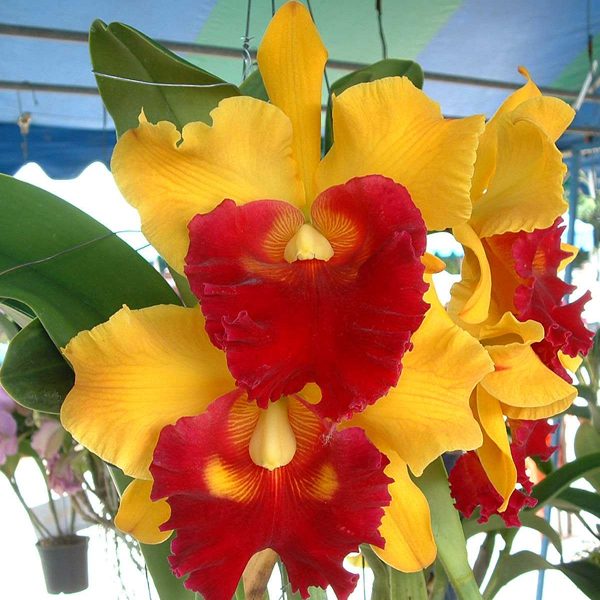
What These Orchids Are and Where They Come From
Cattleya hybrids are orchids created by crossing different species or hybrids within the Cattleya alliance. This group includes plants with names starting in Blc, Lc, Bc, and Potinara. These abbreviations stand for specific intergeneric hybrids. Blc means Brassolaeliocattleya, a cross involving Brassavola, Laelia, and Cattleya. Lc means Laeliocattleya, a cross between Laelia and Cattleya. Bc means Brassocattleya, a cross between Brassavola and Cattleya. Potinara refers to hybrids that once included Brassavola, Cattleya, Laelia, and Sophronitis, but now, since Sophronitis is considered part of Cattleya, they are effectively Brassavola, Cattleya, and Laelia crosses, making them similar to Blc. These orchids come from cultivated breeding programs, not found naturally in the wild. They are grown for their large, showy flowers and are popular among orchid enthusiasts.
How to Recognise Them
These hybrids are recognised by their growth habit and flower structure. They typically have tall, upright pseudobulbs with one or two thick, leathery leaves at the top. The flowers emerge from a sheath at the top of the pseudobulb and are often large and fragrant. The sepals and petals are usually broad and spreading, while the lip is often showy, sometimes fringed or ruffled, and may have contrasting colours or patterns. The column in the centre of the flower is distinctive, often with side structures that help in identification. The abbreviations in the name — Blc, Lc, Bc, or Potinara — tell you the parent genera involved. For example, a plant named Brassolaeliocattleya has Brassavola, Laelia, and Cattleya in its background. Flower colour and form vary widely due to breeding, but the overall plant structure remains consistent across the group.
A Short History of Breeding
Breeding of these hybrids began as growers sought to combine the best traits of different species. Brassavola contributes fragrance and night-blooming tendencies. Laelia brings resilience and varied flower shapes. Cattleya provides large, bold blooms and a wide range of colours. Early crosses were made to improve flower size, colour, and ease of growing. Over time, breeders focused on creating compact plants with multiple flowers and strong stems. The use of mericloning — cloning plants from tissue — allowed award-winning hybrids to be reproduced exactly. This is why many plants in the library are mericlones. The goal has always been to produce orchids that are beautiful, reliable, and suitable for home growing with proper care.
Awards and Competition
Many plants in the library have received awards from orchid societies. These awards are marked by letters after the cultivar name. AM stands for Award of Merit. HCC means Highly Commended Certificate. JC is a Judges’ Certificate. SM is a Special Medal. FCC is a First Class Certificate. BM is a Bronze Medal. The letters after the slash indicate which society gave the award: AOS is the American Orchid Society. OSROC is the Orchid Society of the Republic of China. JGP is likely the Japan Grand Prix. CST may be the Chiang Mai Orchid Society. TOGA is the Thai Orchid Growers’ Association. For example, Brassolaeliocattleya Chun Yeah ‘Yellow Swallow’ AM/OSROC received an Award of Merit from the Orchid Society of the Republic of China. Brassolaeliocattleya Chia Lin ‘Red Rose’ AM/AOS, SM/JGP earned both an Award of Merit from the American Orchid Society and a Special Medal from the Japan Grand Prix. Brassocattleya Nodata ‘Maili’ HCC/AOS received a Highly Commended Certificate from the American Orchid Society. Potinara Ahchung Yoyo ‘Little Goldfish’ BM/TOGA earned a Bronze Medal from the Thai Orchid Growers’ Association. These awards reflect recognition of outstanding flower quality, form, colour, or plant habit in judged competitions.
How to Grow Them at Home in Plain Steps
Grow these orchids in bright, indirect light. An east-facing window is ideal, or a south or west window with sheer curtain to filter strong sun. They need good air movement to prevent rot. Use a well-draining orchid mix, such as bark-based medium, and repot every two years or when the medium breaks down. Water when the top layer of the mix feels dry, then water thoroughly until it runs out the bottom. Do not let the pot sit in water. Fertilise regularly during growing season with a balanced orchid fertilizer at half strength. Reduce feeding in winter. Keep temperatures between 18 and 30 degrees Celsius. They tolerate typical indoor conditions but prefer warmer days and cooler nights. Humidity above 50 percent helps, but they adapt to average home humidity if watered correctly. Watch for signs of stress: yellow leaves may mean too much light or water, dark green leaves may mean too little light. With basic care, they bloom once a year, often in spring or autumn, and can live for many years.
What Our Library Holds
The library contains 160 plants in the Blc, Lc, Bc, and Potinara group. Of these, 150 are mericlones — exact copies of award-winning or desirable hybrids — and 10 are seedling hybrids, grown from seed and showing natural variation. The library includes many award-winning examples, such as Brassolaeliocattleya Chun Yeah ‘Yellow Swallow’ AM/OSROC, Brassolaeliocattleya Sa-Ngob Delight ‘Sa-Ngob’ AM/AOS, Laeliocattleya Mem Robert Strait ‘Blue Hawaii’ JC/AOS, and Brassolaeliocattleya Irene Finney ‘York’ AM/AOS. Other named varieties include Brassolaeliocattleya Norman’s Bay × Blc Greenwich ‘Elmhurst’ AM/AOS, Brassocattleya Nodata ‘Maili’ HCC/AOS, Laeliocattleya Mari’s Song ‘CTM 217’ HCC/AOS, and Potinara Ahchung Yoyo ‘Little Goldfish’ BM/TOGA. The library also holds plants with parentage like Brassocattleya Star Trek ‘Orange’ from Cattleya intermedia × Brassavola perrinii, and Brassolaeliocattleya Sa-Ngob Delight ‘Sa-Ngob’ from Blc Dorcille Little × Cattleya Interglossa. These represent the range of breeding and recognition within the group.
Sources
Based on: Orkpedia library records · Wikipedia · Wikipedia · Wikipedia · Wikipedia. Written and checked by the Orkpedia editors.