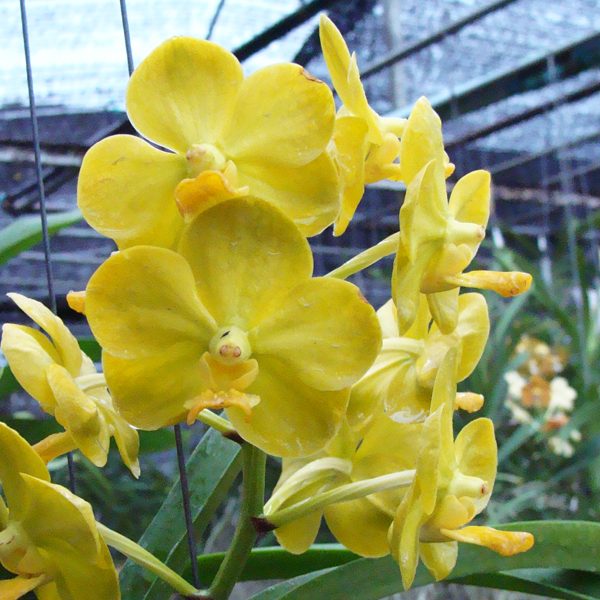
What Ascocenda Orchids Are and Where They Come From
Ascocenda orchids are human-made hybrids created by crossing plants from the Ascocentrum and Vanda genera. These hybrids combine traits from both parents: the compact growth and vibrant color of Ascocentrum with the larger flower size and strong growth habit of Vanda. Although Ascocentrum is now considered part of the Vanda genus in modern classification, the name Ascocenda remains in use for these specific hybrids. They are evergreen epiphytes, meaning they naturally grow on trees or rocks rather than in soil, absorbing moisture and nutrients from the air and rain. Their native origins trace back to tropical regions of East and Southeast Asia, where both parent genera are found in the wild.
How to Recognise Ascocenda Orchids
Ascocenda plants have upright, narrow, oviform leaves that are thick and leathery. They grow in a monopodial pattern, meaning they develop from a single growing point at the top of the stem. The inflorescence appears as an axillary cluster—emerging from the leaf axil—and typically bears six to eight open flowers at a time. Blooms can occur two or even three times a year, with each flower lasting a long time. The flowers are known for their bright, intense colours, often showing contrasting overlays or patterns. This combination of compact size, frequent blooming, and vivid colour makes them stand out in collections.
A Short History of Breeding
The Ascocenda hybrid was first created in 1949, as documented in Orchid Rev. 57: 172. Since then, breeders have developed numerous cultivars by crossing various Ascocenda lines with Vanda and related genera. These efforts have focused on enhancing flower colour, improving plant compactness, and increasing bloom frequency. Over time, many secondary hybrids have emerged, including crosses between Ascocenda and other genera like Rhynchostylis, leading to related groups such as Vascostylis. The library data shows ongoing breeding work, with many named cultivars reflecting parentage from well-known lines such as Ascocenda Peggy Foo, Vanda Kultana Gold, and Ascocenda Tubtim Velvet.
Awards and Competition
Two award-winning Ascocenda plants are listed in the library data, both recognised by the American Orchid Society (AOS). The first is Ascocenda Su-fun Beauty ‘Orange Belle’ with the designation AM/AOS. According to the award key, AM stands for Award of Merit, given to orchids scoring between 80 and 89 points on a 100-point scale for flower quality. The second is Ascocenda Bicentennial ‘Carmela’ AM/AOS, which also received an Award of Merit from the AOS under the same criteria. These awards indicate that both plants were judged to have flowers of high quality, though not reaching the highest level of FCC (First Class Certificate), which requires 90 points or more.
How to Grow Them at Home
Ascocenda orchids thrive in bright, indirect light, similar to what they would receive under a tropical tree canopy. Direct midday sun should be avoided to prevent leaf burn. They prefer warm temperatures and high humidity, reflecting their native forest habitat. Watering should be frequent during active growth, allowing the roots to dry slightly between sessions but never letting the plant remain soggy. Good air circulation is essential to prevent rot, especially in humid conditions. These orchids are typically grown in open baskets or mounted on slabs to mimic their epiphytic nature, using little or no traditional potting medium. Fertiliser can be applied regularly during the growing season at a weak strength. Since they are monopodial, they do not have pseudobulbs to store water, so consistent moisture is important. Repotting or remounting is best done when new roots are appearing, usually in spring or early summer.
What Our Library Holds
The library contains 50 Ascocenda and related plants in total. Of these, 41 are mericlones—propagated through tissue culture to preserve the exact traits of the parent plant—and 9 are seedling hybrids, grown from seed and therefore showing natural variation. Example plants in the collection include Ascocenda Su-fun Beauty ‘Orange Belle’, Ascocenda Bicentennial ‘Carmela’, Ascocenda Chainarin, Ascocenda Princess Mikasa ‘Blue’, and Ascocenda Louise Coffey. Related Vascostylis examples include Vascostylis Pine Rivers ‘Pink’, Vascostylis Thai Sky, and Vascostylis Velvet ‘Perfection’. These examples illustrate the range of colours, forms, and parentage available in the group, from pink and blue hues to gold and red tones, often derived from well-known parent lines such as Ascocenda Tubtim Velvet, Vanda Kultana Gold, and Rhynchostylis coelestis.
Growing Conditions and Care
Ascocenda and related hybrids require bright, filtered light to thrive, similar to their Vanda ancestors. They prefer warm temperatures, ideally between 18°C and 30°C, and high humidity levels, often above 60%. Watering should be frequent during active growth, allowing the roots to dry slightly between sessions but never letting the plant remain soggy. Good air circulation is essential to prevent rot, especially in humid conditions. These orchids are typically grown in open baskets or mounted on slabs to mimic their epiphytic nature, using little or no traditional potting medium. Fertiliser can be applied regularly during the growing season at a weak strength. Since they are monopodial, they do not have pseudobulbs to store water, so consistent moisture is important. Repotting or remounting is best done when new roots are appearing, usually in spring or early summer.
Award-Winning Cultivars in the Collection
Two plants in the library have received formal recognition from the American Orchid Society. Ascocenda Su-fun Beauty ‘Orange Belle’ holds an Award of Merit (AM/AOS), indicating a flower quality score between 80 and 89 points on the AOS 100-point scale. Ascocenda Bicentennial ‘Carmela’ also holds an Award of Merit (AM/AOS), reflecting the same range of flower quality achievement. These awards are based on evaluations of floral characteristics such as colour, form, size, and substance, as defined by the AOS judging standards.
Parentage and Breeding Lines
Several hybrids in the library trace their lineage to well-known parent lines. Ascocenda Su-fun Beauty ‘Orange Belle’ is a cross between Vanda Bangkapi and Ascocenda Pralor. Ascocenda Bicentennial ‘Carmela’ results from crossing Ascda Bonanza with Ascda Yip Sum Wah. Ascocenda Chainarin is derived from Ascocenda Crownfox Midnight Delight and Vanda Doctor Anek. Ascocenda Princess Mikasa ‘Blue’ comes from Ascocenda Royal Sapphire and Vanda coerulea. Ascocenda Louise Coffey is a hybrid of Ascocenda Tubtim Velvet and Yip Sum Wah. Vascostylis Pine Rivers ‘Pink’ is produced from Ascocenda Peggy Foo and Rhynchostylis coelestis. Vascostylis Velvet ‘Perfection’ (also listed as Vascostylis Viboon Velvet ‘Perfection’) shares the same parentage: Ascocenda Tubtim Velvet crossed with Rhynchostylis coelestis. Vascostylis Thai Sky is a hybrid of Vascostylis Charlotte Oestreicher and Vascostylis Tham Yuen Hae. These crosses illustrate breeding efforts focused on colour, form, and floral vigor, often combining traits from Vanda, Ascocentrum, and Rhynchostylis lineages.
Sources
Based on: Orkpedia library records · Wikipedia · Wikipedia · Wikipedia. Written and checked by the Orkpedia editors.