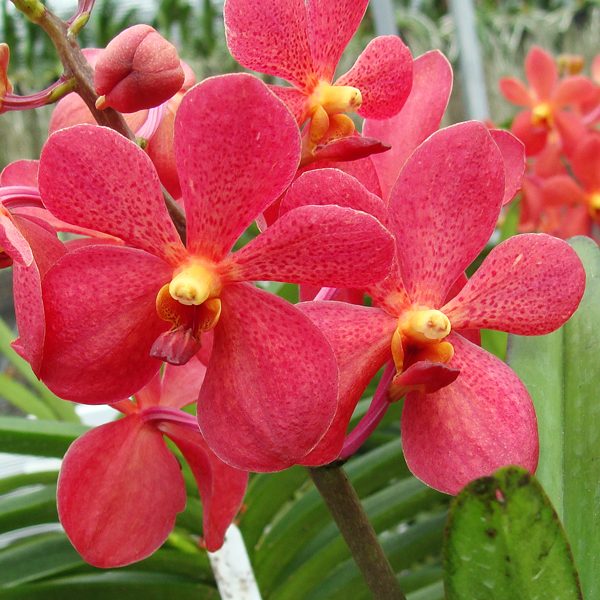
What These Orchids Are and Where They Come From
Mokara, Aranda and Kagawara are hybrid orchids created by crossing different genera. Aranda comes from a cross between Arachnis and Vanda. Mokara involves Arachnis, Ascocenda and Vanda in its background. Kagawara combines Renanthera and Ascocenda. These hybrids were developed in Southeast Asia for the cut-flower trade. They grow well in warm, humid climates and are valued for their strong stems and long-lasting blooms. The parent species come from regions including China, the Himalayas, Southeast Asia, New Guinea, Melanesia, India, the Philippines, Indonesia and northern Australia.
How to Recognise Them
These orchids have tall, upright flower spikes with many blooms opening in sequence. Aranda flowers often show the spider-like shape of Arachnis combined with the roundness of Vanda. Mokara blooms tend to be compact and waxy, with colours ranging from gold to orange and red. Kagawara flowers are known for their intense reds and oranges, inherited from Renanthera, and are carried on branching stems. The leaves are usually broad and strap-like, typical of Vanda relatives. The plants grow monopodially, meaning they have a single main stem that grows upward from the base.
A Short History of Breeding
Breeding of these hybrids began in Southeast Asia to produce orchids suitable for commercial cut-flower production. Aranda was one of the first successful intergeneric crosses, combining Arachnis hookeriana and Vanda. Over time, breeders added Ascocenda and Renanthera to expand colour range and flower form. Mokara and Kagawara followed as further refinements. The goal was to create plants with strong stems, long-lasting flowers and colours that stood out in arrangements. Many of the hybrids in the library trace back to well-known parent lines such as Vanda Dawn Nishimura, Ascocenda Memoria Choo Laikeun and Renanthera Nancy Chandler.
Awards and Competition
Our library data shows award-winning plants in this group. The award notation HCC/AOS means the plant received a Highly Commended Certificate from the American Orchid Society. This award is given to orchids scoring 75 to 79 points on a 100-point scale for flower quality. The plant Kagawara Christie Low ‘Redland’ appears three times in our library data with this award. Each entry refers to the same mericlone, recognised for its flower quality. No other awards such as AM, FCC, CCM, CCE or JC are listed for these plants in our current library data.
How to Grow Them at Home
These orchids need bright, indirect light. A south or east-facing window with sheer curtain is ideal. Water when the top layer of the potting medium feels dry. Use a coarse mix that drains well, such as bark, charcoal and perlite. They prefer warm temperatures and good air movement. Mist the leaves occasionally if the air is dry. Feed with a balanced orchid fertilizer every two weeks during growing season. Reduce feeding in cooler months. Repot every two years or when the medium breaks down. They can be grown in pots or baskets. Watch for signs of rot if roots stay too wet.
What Our Library Holds
Our library contains 57 plants in the Mokara, Aranda and Kagawara group. All are mericlones, meaning they are propagated by tissue culture to preserve the exact traits of the parent plant. There are no seedling hybrids in this section of the catalogue. Example plants include Aranda Noorah Alsagoff Pink, which comes from Arachnis hookeriana and Vanda Dawn Nishimura. Mokara Luenberger Gold is derived from Mokara Khaw Phaik Suan and Vanda Kultana Gold. Mokara Dolal Miah comes from Arachnis Ishbel and Ascocenda Wangsa Gold. Aranda Woleco is a cross between Aranda Christine and Vanda Doctor Anek. Other examples are Aranda Wan Chark Kuan, Aranda Prapin Beauty, Kagawaara Samrerng, Mokara Madame Panni, Aranda Tan Mei Ying and Mokara Toddman. These examples show the range of parent combinations used to create these cut-flower orchids.
Award-Winning Plants in the Collection
Three award-winning plants are listed in the library catalogue for the Mokara, Aranda, and Kagawara group. All three are Kagawara Christie Low ‘Redland’ and have received an HCC/AOS award. The HCC (Highly Commended Certificate) is awarded by the American Orchid Society to orchids scoring 75 to 79 points on a 100-point scale for flower quality.
Parentage of Notable Hybrids
Kagawara Christie Low ‘Redland’ HCC/AOS is a hybrid between Renanthera Nancy Chandler and Ascocenda Memoria Choo Laikeun. Kagawaara Samrerng results from a cross between Renanthera Nancy Chandler and Ascocenda Madame Panni. Mokara Madame Panni is derived from Mokara Sayan and Vanda Charles Goodfellow. Aranda Tan Mei Ying comes from Vanda Mabelmae Kamahele and Aranda Christine. Mokara Toddman is a hybrid of Mokara Sayan and Ascocenda Fuchs Sunset.
Additional Examples in the Catalogue
Other plants in the library include Aranda Wan Chark Kuan, which is a cross between Aranda Lily Chong and Vanda Memoria Fumiko Omoto. Aranda Prapin Beauty is produced from Aranda Christine and Vanda Rasri Gold. Mokara Luenberger Gold originates from Mokara Khaw Phaik Suan and Vanda Kultana Gold. Mokara Dolal Miah is a hybrid of Arachnis Ishbel and Ascocenda Wangsa Gold. Aranda Woleco results from Aranda Christine and Vanda Doctor Anek. Aranda Noorah Alsagoff Pink is derived from Arachnis hookeriana and Vanda Dawn Nishimura.
Sources
Based on: Orkpedia library records · Wikipedia · Wikipedia · Wikipedia. Written and checked by the Orkpedia editors.