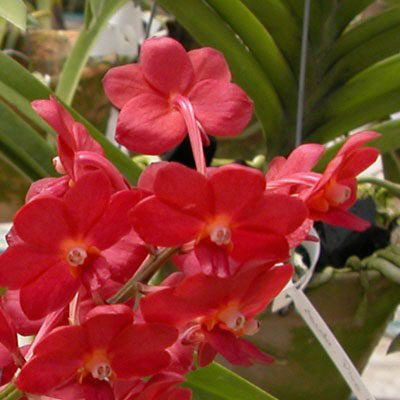
What Vanda orchids are and where they come from
Vanda orchids belong to a genus in the orchid family known for their showy, fragrant, long-lasting, and intensely colorful flowers. They are monopodial plants, meaning they grow from a single stem with leaves arranged along it. The leaves are typically flat, broad, and ovoid in shape, often described as strap-leaves. Some species have cylindrical, fleshy leaves adapted to dry periods, but these are now classified in a separate genus called Papilionanthe. Vanda plants vary greatly in size, from miniature forms to specimens with stems several meters long. In both natural habitats and cultivation, they can become quite large, especially epiphytic types that develop extensive, rambling aerial root systems. These roots have small openings called pneumatodes that help with gas exchange. The flowers grow on lateral inflorescences and are usually few to many in number. While many show yellow-brown colors with brown markings, they also appear in white, green, orange, red, and burgundy shades. The lip of the flower has a small spur. Vanda species typically bloom every few months, and each flower lasts two to three weeks. Naturally, they are found across East Asia, Southeast Asia, and New Guinea, with some species extending into Queensland and islands of the western Pacific. Their distribution also includes India, the Himalayas, Indonesia, the Philippines, southern China, and northern Australia.
How to recognise Vanda orchids
Vanda orchids can be recognised by their monopodial growth habit, where the plant grows upward from a single stem. The leaves are usually flat, broad, and ovoid, resembling straps, and are arranged alternately along the stem. The aerial root system is a key feature — these roots are thick, silvery-green, and grow freely in the air, often hanging down from the plant or attaching to nearby surfaces. The roots have small openings called pneumatodes, which aid in respiration. The flowers grow sideways from the stem on a lateral inflorescence and are known for their large size, waxy texture, and intense coloration. While color varies, many display bold hues like purple, blue, red, or orange, often with contrasting markings. The lip of the flower is prominent and usually has a small spur at the base. Unlike some orchids that bloom once a year, Vandas tend to flower every few months under good conditions, with each bloom lasting two to three weeks. These traits — especially the aerial roots, strap-like leaves, and frequent colorful blooms — help distinguish Vandas from other orchid genera.
A short history of breeding
Vanda orchids have been bred for their striking flowers and adaptability to cultivation. Hybridisation has played a major role in developing varieties with improved color, form, and blooming frequency. One notable example is Papilionanthe Miss Joaquim, originally classified as Vanda Miss Joaquim, which is a natural hybrid between Vanda hookeriana and Vanda teres. It was discovered in Singapore and later became the nation’s national flower due to its resilience and year-round blooming. Another example is Vanda Pachara Delight, which results from crossing Vanda Karulea and Vanda Gordon Dillon. Vanda Robert’s Delight ‘Garnet Beauty’ and Vanda Robert’s Delight ‘Somsri’ both come from the cross between Vanda Kasem’s Delight and Vanda Madame Rattana. Vanda Tharab Beauty is a hybrid of Vanda Thong Chai and Sirilak. Vanda Dr Anek AM × Vanda comes from Gordon Dillon Pink crossed with Bitz’s Heartthrob. Vanda Gypsy’s Rocket is a cross between Vanda Manuvadee and Vanda Madame Rattana. Vanda Pure’s Wax ‘Purple Blue’ results from Vanda Doctor Anek crossed with Vanda Kasem’s Delight. Vanda Mimi Palmer ‘Teo Boon Hian’ HCC RHT is derived from Vanda Tan Chay Yan and Vanda tessellata. Vanda Mas Los Angeles comes from Vanda Mevr. L. Velthuis and Vanda Sunray. Vanda Lady Rebekah Kao is a hybrid of Vanda Bang Sai Queen and Vanda Manuvadee FCC. These crosses show how breeders combine species and hybrids to create new varieties with desirable traits such as color intensity, flower size, and growth habit.
Awards and competition
Several Vanda orchids in our library have received formal recognition for flower quality. The award key explains the meaning of each designation. HCC, or Highly Commended Certificate, is given to orchids scoring 75 to 79 points on a 100-point scale for flower quality. AM, or Award of Merit, is awarded to those scoring 80 to 89 points. FCC, or First Class Certificate, is the highest flower-quality award, given to orchids scoring 90 points or more. CCM, or Certificate of Cultural Merit, recognises exhibitors of well-flowered, robust plants that have been in their care for at least 12 months and score 80 to 89 points for culture. In our library, the following plants have received awards: Vanda Doctor Anek FCC; Vanda Kasem’s Delight AM × Blitz Heartthrob; Vanda Robert’s Delight ‘Garnet Beauty’ FCC; Vanda Robert’s Delight ‘Somsri’ AM; Vanda Doctor Anek FCC × V Blitz Heartrob; Vanda Dr Anek AM × Vanda; Vanda Pakchong New Land × Vanda Doctor Anek FCC 4N; Vanda Mimi Palmer ‘Teo Boon Hian’ HCC RHT; Vanda Pat Delight ‘Pink Tango’ AM/AOS; Vanda Pachara Delight FCC/JOGA; Vanda Renachai AM; and Vanda Pachara Delight FCC/JOGA (listed twice). These awards indicate that these orchids have been judged to have exceptional flower quality, with FCC recipients representing the highest standard.
How to grow them at home
Growing Vanda orchids at home requires attention to light, water, air, and roots. They need bright, filtered light — direct midday sun can damage the leaves, but insufficient light will reduce flowering. A south or east-facing window with sheer curtain is often ideal. Unlike many orchids, Vandas are often grown without potting media. Their roots should be allowed to hang freely in the air, as they absorb moisture and nutrients from the environment. Watering should be done daily or every other day, depending on humidity, by spraying the roots until they turn silvery-green. In dry climates, misting may be needed more than once a day. Fertiliser should be applied regularly during the growing season using a balanced orchid fertiliser at weak strength, either in the water or as a foliar spray. Good air movement is essential to prevent rot and promote healthy roots. Temperatures should be warm, ideally between 18°C and 30°C, with no cold drafts. Since Vandas are epiphytic, they do not tolerate soggy conditions — roots must dry quickly after watering. If grown in a basket or mounted on wood, ensure the base allows for drainage and airflow. Repotting is rarely needed unless the plant outgrows its support. Remove any dead or damaged roots with sterile tools. With consistent care, Vandas can produce multiple flushes of flowers each year.
What our library holds
Our library contains 118 Vanda orchids in total. Of these, 80 are mericlones — plants propagated through tissue culture to be genetically identical to the parent. The remaining 38 are seedling hybrids, grown from seed and therefore genetically unique. These plants represent a range of awarded and notable varieties. Examples include Vanda Doctor Anek FCC, which has received the highest flower-quality award. Vanda Robert’s Delight ‘Garnet Beauty’ FCC and Vanda Robert’s Delight ‘Somsri’ AM show how sibling seedlings from the same cross can earn different awards based on flower quality. Vanda Mimi Palmer ‘Teo Boon Hian’ HCC RHT has earned a Highly Commended Certificate, indicating strong flower quality. Vanda Pachara Delight FCC/JOGA appears twice in the list, suggesting it may be a particularly notable line or has been recognised by multiple judging systems. Other awarded plants in the collection include Vanda Kasem’s Delight AM × Blitz Heartthrob, Vanda Doctor Anek FCC × V Blitz Heartrob, Vanda Dr Anek AM × Vanda, Vanda Pakchong New Land × Vanda Doctor Anek FCC 4N, Vanda Pat Delight ‘Pink Tango’ AM/AOS, and Vanda Renachai AM. These plants reflect the library’s focus on high-quality, award-winning Vanda hybrids that are valued for their beauty and genetic merit.
Sources
Based on: Orkpedia library records · Wikipedia · Wikipedia · Wikipedia. Written and checked by the Orkpedia editors.