What Cattleya Orchids Are and Where They Come From
Cattleya is a genus of orchids native to regions from Costa Rica down to Argentina. These plants grow either on trees as epiphytes or in the ground as terrestrials. They develop from a cylindrical rhizome that produces fleshy, noodle-like roots. The pseudobulbs are typically conical, spindle-shaped, or cylindrical and grow upright, bearing one or two leaves at the top. The leaves are oblong, lanceolate, or elliptical, somewhat fleshy with smooth edges. Flowers appear on a terminal raceme and feature separate sepals and petals. The lip, or labellum, is usually distinct in color and shape and partially forms a tube around the flower column. Each flower contains four pollinia, which are bag-like structures holding pollen. The fruit is a capsule containing many tiny seeds. The genus was named in 1824 by John Lindley in honor of William Cattley, who first bloomed a specimen of Cattleya labiata obtained from William Swainson in Pernambuco, Brazil, in 1817.
How to Recognise Cattleya Orchids
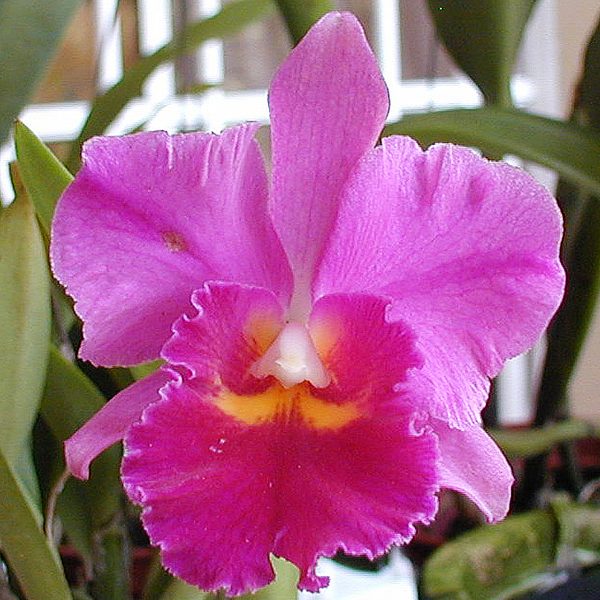
Cattleya orchids can be identified by their growth habit and floral structure. They have pseudobulbs that store water and nutrients, from which one or two leathery leaves emerge. The flower spike grows from the top of the pseudobulb and bears several large, showy blooms. The petals and sepals are similar in appearance and spread outward, while the lip is often broader, frilled, or differently colored, sometimes forming a tubular shape around the column. The presence of four pollinia is a key internal feature. These orchids are often fragrant and valued for their vibrant colors and elegant form, making them popular in cultivation and exhibitions.
A Short History of Breeding
Breeding of Cattleya orchids has involved both species and hybrids, often crossing with related genera to create new combinations. Natural hybrids occur in the wild, and horticulturists have developed numerous artificial hybrids. These include nothogenera such as × Brassocattleya (Brassavola × Cattleya), × Brassolaeliocattleya (Brassavola × Cattleya × Laelia), × Cattleytonia (Cattleya × Broughtonia), × Laeliocattleya (Cattleya × Laelia), and × Rhyncholaeliocattleya (Rhyncholaelia × Cattleya). Breeding efforts have focused on improving flower size, color, form, and resilience, leading to the diverse range of cultivars seen today.
Awards and Competition
Our library data includes several award-winning Cattleya and related hybrids, each recognised by the American Orchid Society (AOS) for flower quality. The award key explains the meaning of the letters used in the catalogue. HCC (Highly Commended Certificate) is given to orchids scoring 75 to 79 points on a 100-point scale for flower quality. AM (Award of Merit) is awarded for scores of 80 to 89 points. FCC (First Class Certificate) is the highest flower-quality award, given for scores of 90 points or more. CCM (Certificate of Cultural Merit) recognises exhibitors of healthy, well-flowered plants that have been in their care for at least 12 months and score 80 to 89 points for culture. CCE (Certificate of Cultural Excellence) is similar but requires a culture score of at least 90 points. In our library, the following plants have received awards: Cattleya Hawaii Wedding Song ‘Virgin’ HCC/AOS; Epilaeliocattleya Don Herman ‘Butterball’ HCC/AOS; Hawkinsara Sogo Doll ‘Little Angel’ AM/AOS; Cattleya violacea ‘Muse’ FCC/AOS; Cattleya Hawaiian Wedding Song ‘Virgin’ HCC/AOS (noted twice in the data); and Cattleytonia Rosy Jewel ‘Ewa’ AM/AOS. These awards reflect the plants’ excellence in flower form, color, and overall quality as judged by AOS standards.
How to Grow Them at Home
Growing Cattleya orchids at home requires attention to light, temperature, humidity, watering, and fertilizing. They need bright light but should be protected from direct, intense sunlight, which can damage the leaves; shade should be provided when necessary. Day temperatures should range from 25 to 30 °C (77 to 86 °F), while night temperatures should not fall below 10 to 12 °C (50 to 53.6 °F). Humidity must be maintained between 40 and 70 percent, with good air circulation to prevent stagnation, though plants should not be placed in direct drafts. Watering should occur only when the growing medium is dry to the touch; frequency varies with conditions and season, but a weekly schedule is a common starting point. Fertilizing is not strictly necessary, but if used, nitrogen-based fertilizers without urea are recommended during the growth period. To prevent salt buildup in the substrate, water thoroughly between applications. These practices support healthy growth and regular flowering.
What Our Library Holds
Our library catalogue contains 37 Cattleya-related plants, consisting of 31 mericlones and 6 seedling hybrids. Among these are several award-winning specimens recognised by the American Orchid Society. Examples of plants in the collection include Cattleya Bangkok ‘Ruby’, which is a cross between Cattleya Isis and Cattleya Meteor; Epilaeliocattleya Don Herman ‘Butterball’ HCC/AOS, derived from Cattlianthe Gold Digger × Epidendrum stamfordianum; Cattleya violacea ‘Yen’, from C amethystoglossa × Lc Ann Follis; Brassolaelia Yellow Bird, from Brassolaelia Richard Mueller × Brassavola nodosa; Sophrolaeliocattleya Anzac Jewel, from Slc. Anzac × Slc. Jewel Box; Cattleya Hawaiian Wedding Song ‘Virgin’ HCC/AOS, from Cattleya Angel Bells × Cattleya Claesiana; Cattleytonia Rosy Jewel ‘Ewa’ AM/AOS, from Guarianthe bowringiana × Broughtonia sanguinea; Laeliocatonia Happy Face, from Cattleytonia Peggy San × Cattleya Mari’s Song; Cattleya Marjorie Hausermann, from Cattleya Henrietta Japhet × Cattleya Ethel Leder; and Rhyncholaeliocattleya Hsinying Pachi Pachi ‘Rie’, from Blc Haw Yuan ‘Delight’ × Golden Delight. Other example names in the catalogue are Cattleya Netrasiri Fame, Sophrolaeliocattleya Netrasiri Doll ‘Bicentenial’, Cattleya Porntip ‘Joe’, Cattleya Netrasiri Waxy × Love Knot, Hawkinsara Sogo Doll ‘Little Angel’ AM/AOS, Brassolaelia Yellow Bird, Cattleya Fireball Fame × Blc Lucky Strike, Cattleya Fireball Fame × Blc Bryce Canyon, Sophrolaeliocattleya Anzac Jewel, Cattleya Yen Red Face, and Cattleya Blc Greenwich Elmhurst. These represent a sample of the diversity preserved in our library.
Sources
Based on: Orkpedia library records · Wikipedia. Written and checked by the Orkpedia editors.